
E-mail:
qyszhjx@163.comCall Us:
+86-391-5935000
Paper machine is a complete set of equipment which make paper from paper pulp,include headbox,cylinder section,pressure seciton,dryer section,calendar section,winding machine,rewinding machine,drive section etc and other auxiliary system such as steam,water,vacuum,lubrication and heat recovery. According to machine model,usually have cylinder mold and fourdrinier machine,also could divided into toilet paper making machine,culture paper machine,kraft/corrugated paper making machine and other special paper machine(mosquito coil paper machine,insole board paper making machine etc) according to finished paper product.
A paper machine (or paper-making machine) is an industrial machine which is used in the pulp and paper industry to create paper in large quantities at high speed. Modern paper-making machines are based on the principles of the Fourdrinier Machine, which uses a moving woven mesh to create a continuous paper web by filtering out the fibres held in a paper stock and producing a continuously moving wet mat of fibre. This is dried in the machine to produce a strong paper web. The basic process is an industrialised version of the historical process of hand paper-making, which could not satisfy the demands of developing modern society for large quantities of a printing and writing substrate.

Paper carton box making machines are essential tools in the production of packaging materials for a wide variety of industries. These machines come in various models with different production capacities and features to cater to the needs of various businesses.
Read More
Corrugated paper machine is a type of machinery that is specifically designed for the production of corrugated paper. There are a few different models of corrugated paper making machine available on the market today, with each model offering its own unique set of benefits and...
Read More
Paper board Machine is a specialized machine that is used to manufacture paper board, which is a type of thick and durable paper used for packaging and similar purposes. There are various models of paper board machines available in the market, each with its own specific...
Read More
The most common types of corrugated board machines are single faced, double faced, and triple faced. Single faced machines produce a single layer of corrugated board, while double faced machines produce two layers and triple faced machines produce three layers.
Read More
Corrugated carton box making machine is a crucial equipment for producing high-quality cardboard boxes. There are different model versions available in the market, each with its own unique features and benefits. In this article, we will focus on the general features and...
Read More
The paper egg tray machine is an innovative piece of equipment that is designed specifically for the manufacture of egg trays. This machine boasts a number of features and advantages that make it a popular choice for egg tray manufacturers worldwide.One of the key features of...
Read More
Tissue paper manufacturing plant is a modern machine used to produce tissue paper for various applications. This machine is engineered with several advantages that make it stand out among other similar machines in the market. In this article, we will explore the construction...
Read More
Kraft envelope making machine is a revolutionary equipment designed to enhance the productivity of envelope manufacturing. The machine comes with several features that make it a valuable investment for businesses looking to enhance efficiency in envelope production.The making...
Read More
Newspaper making machine is a state-of-the-art piece of equipment that transforms raw materials into premium-quality newspapers. Thanks to its advanced technology, this machine provides high efficiency and stable production, ensuring that your business can enjoy an...
Read More
Kraft Paper Making Machine usually use waste carton paper as raw material. The weight of the paper it produces is 80-120gsm. The main quality requirements of the produced paper are strong flexibility, high resistance to rupture, and can withstand greater tension and pressure...
Read More
Cardboard Paper Machine is similar with these paper machines. But becaused of the high thickness of cardboard, its molding machine consists of the same or different molding machines, and is equipped with multiple pre-presses and multiple main presses.
Read More
A4 paper making machine is mainly make A4 paper from virgin pulp, finished product could be paper roll or paper sheet, buyer could cut to A4 size paper after slitting machine, paper machine type usually is fourdrinier, paper weight is 70-80gsm.
Read MoreCost-effective
Paper pulp making machines are highly cost-effective compared to traditional pulp manufacturing methods. Manual pulp production processes are time-consuming, labor-intensive, and require a significant amount of resources. The process involves manually cutting and shredding paper, soaking it in water, and manually agitating the mixture to create a pulp. This process is not only slow but also requires a significant amount of human resources, which can be expensive.
Efficient
Paper pulp making machines are highly efficient compared to traditional pulp manufacturing methods. Manual pulp production processes are time-consuming and labor-intensive, which can result in a slower rate of production. The manual process involves soaking paper in water, manually agitating the mixture, and then manually cleaning and refining the pulp. This process is not only time-consuming but also requires a significant amount of human resources.
Environmentally Friendly
Paper pulp making machines are environmentally friendly compared to traditional pulp manufacturing methods. Manual pulp production processes require a significant amount of water, energy, and chemicals, which can have a significant impact on the environment. The manual process also produces a significant amount of waste, which can be challenging to dispose of safely.
Versatile
Paper pulp making machines are versatile, and they can produce various types of paper products. The machines can produce products such as egg trays, paper plates, disposable cups, and packaging materials, among others. The versatility of the machine makes it an attractive option for paper manufacturers, as it allows them to diversify their product lines.
Our Factory
Qinyang City Zhenghua Paper Machinery CO., Ltd is located in Qinyang City, Henan province, China, is a collection of scientific research, design, manufacturing, marketing and service in one of the large-scale papermaking equipment enterprises.
Our Product
The company mainly manufacture all kinds of high-strength corrugated / linerboard machine (used in the production of various types of paper packaging), culture paper machine for the production of printing paper/ A4 paper, toilet paper machine for the production of high-grade household paper, napkins, paper towels etc, special paper making machine include mosquito coil making machine,insole board paper making machine,recycled leather making machine and could supply all kinds of paper making pulping equipment and the spare parts for paper machine.
Main Market
We ensure that our paper machines are of high quality,right mix of quality and price is what we offer to our customer.We have customers from both domestic market and oversea market,main sales market:middle east area,Africa,southeast Asia etc,welcome customers to contact us.
Our Service
The company has first-class sales and technical service team, according to customer requirements to provide project design, process design and technical training, etc.. We provide a pre-sale, sale, the after-sales tracking service, fully eliminate the worries of the majority of customers.Pre-sale service,supply detailed drawing and technical scheme,provide complete and professional consultation service;after-sale service,send professional installation technician to guide machine installation,and provide technical training for your workers.
Automatic Paper Machines
Automatic paper machines are engineered to streamline the production process, minimizing human intervention and enhancing productivity. These automatic paper machines integrate advanced technologies like automation and control systems to ensure consistent quality and optimal performance.
The efficiency of automatic paper machines depends on several factors, including machine foundation design, machine efficiency, and the effective use of a steam system. To maintain high productivity, automatic paper machines require a comprehensive maintenance plan and adherence to safety protocols.
Fourdrinier Machine
The Fourdrinier machine is a staple in the paper manufacturing industry. It employs a moving belt of wire mesh to create a continuous paper web. The process begins with a slurry of pulp that is spread across the mesh, which then passes through various sections for draining, pressing, and drying. The Fourdrinier machine is renowned for its ability to produce high-quality writing paper. To ensure optimal performance, the Fourdrinier machine must be installed with a robust machine foundation design. Regular predictive maintenance is essential to keep the Fourdrinier machine operating efficiently, and compliance with environmental regulations is mandatory to minimize environmental impact. The incorporation of optical brighteners in the process enhances the brightness of the writing paper produced by the Fourdrinier machine.
Cylinder Machine
The cylinder machine uses rotating cylinders covered with a wire mesh to form the paper. This method is particularly suitable for producing thicker paper grades and board materials. The cylinder machine picks up pulp from vats, forming multiple layers that are then pressed and dried. The design and efficiency of the cylinder machine are heavily influenced by the machine foundation design and the steam system used. Regular adherence to a maintenance plan and predictive maintenance can significantly enhance the machine efficiency of the cylinder machine. Additionally, compliance with environmental regulations ensures that the operation of the cylinder machine is sustainable and environmentally friendly. Integrating advanced automation and control systems into the cylinder machine can further enhance its performance and productivity.
Tissue Machine
Tissue machines are specialized for producing tissue paper, characterized by its light weight and softness. These tissue machines often incorporate creping processes to enhance the paper's softness and flexibility. The installation of tissue machines requires meticulous attention to machine foundation design to ensure stability and efficiency. The performance of tissue machines can be optimized through the use of a well-maintained steam system and regular predictive maintenance. Implementing a thorough maintenance plan and adhering to safety protocols are crucial for the safe and efficient operation of tissue machines. Advanced automation and control systems play a vital role in enhancing the performance and consistency of tissue machines. Ensuring compliance with environmental regulations is essential to minimize the environmental impact of the production process. Incorporating optical brighteners can improve the visual quality of the tissue paper produced by tissue machines.
Experience and reputation of the manufacturer
The experience of a manufacturer is essential to businesses because it can indicate that the manufacturer's products are of good quality. Manufacturers developing papermaking machines for a long time will have learned what the industry demands, and will create machines that meet these requirements.
Cost
The cost of the machine will vary depending on the technology used, the machine's output, and its size. Paper machines cost from as low as US $9000 to US $97000. Therefore, businesses should select machines that they can afford, which can still satisfy their needs.
Ease of operation and maintenance
Some paper-making machines may be easy to use, while other machines may not be easy to use. When purchasing a paper-making machine, businesses should first find out whether they are easy to use. Getting a technician from the manufacturer could be helpful to them too. In addition, businesses should enquire on how maintenance of the machine should be carried out as well as the availability of the spare parts. The business could also request training of personnel.
Safety
Businesses should purchase machines with good safety features to ensure the operators' safety. Machines should be operated in rooms that have adequate space to avoid being clipped by nips and pinch points. The correct procedure should always be used when running the machine. Personnel should also be well dressed in protective equipment such as eyewear, ear muffs, overall/coat, and safety boots.
Productivity
Production capacity is the amount of paper produced per unit of time. It is measured in meters per minute, and it varies from machine to machine. Some machines have a production capacity of 200m/min, while others have a capacity of 300m/min. Businesses should select machines with an output that suits their production needs.
Paper size
Paper-making machines have different paper dimensions that they manufacture. The paper width depends on the use of the business. Available paper widths include 1600mm, 1800mm, and 2640mm. Businesses should select the appropriate paper width depending on the needs of their clients.


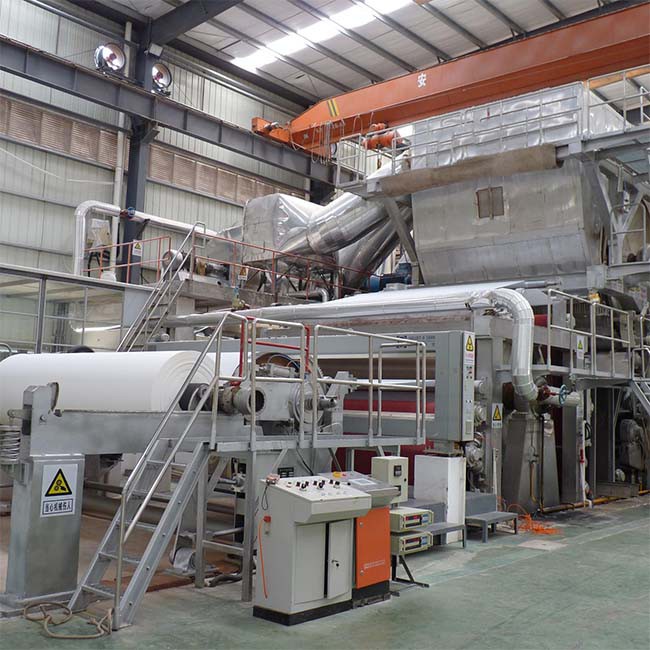
A paper machine is typically 10 - 25 feet wide and can range in length anywhere from half a football field (50 yards) to the full length (100 yards). The machine has two main components; a wet end and a dry end.
Step 1: The pulp mixture and water are spread across a forming fabric which resembles a large mesh screen on the front end, or wet end, of the paper machine.
Step 2: At this point, the pulp is 99.5 % water to 0.5 % pulp. Gravity, suction, and a mechanized vibration of the screen quickly begin to remove 20% of the water, much of which is re-used at the mill. Strict environmental guidelines are followed for the volume and quality.
Step 3: The next step on the wet end is the press section where even more water is removed. With the water still at 60%, the mix gets squeezed through large cloth wrapped cylinders called wet felts. It's at this point in the paper making process that the product starts to get its smoothness and thickness.
Step 4: Once through the felts, the paper enters the dryer section. Here, it passes through steam heated dryers that leave the product with a moisture content of 2-6%.
Step 5: The next stop is the size press; at this point, a starch solution is applied to both sides of the sheet. The starch solution enhances its ability to resist water and ink penetration during the offset printing process. This step of the paper making process also gives the paper the ability to receive toners and liquid inks used in various types of digital printing.
Step 6: As it passes through this process, big, heavy cylinders called the calendar stack await the roll that is forming. These cylinders apply pressure to the sheet to form the desired smoothness and caliper of the paper. The pressure on the calendar stack can be adjusted. More pressure yields smoother paper with less thickness.
Step 7: At the end of the machine, the paper is wound on a large reel called the winder. As the reel of paper goes to the winder, it is slit into manageable size rolls. There are two basic type of roll formats; one is a roll that is sized for a web printing press for sheet fed machines and the second format converts rolls to be used in a sheeting application to be cut and packed into cartons. The winder offers the ability to customize sheeter roll sizes to maximize the efficiency and limit waste.
Step 8: Each finished roll, carton, or skid is stamped with a run number. We often refer to the run number as the birth certificate of the product. The run number displays the date, time, paper machine and which part of the large reel the paper came from.
A full winder reel's worth of paper weighs 30 tons, or a truck and a half of paper. That 60,000 lbs. took about 45 minutes to make from the wet end to the winder.
Head box:
Head box is one of the most important sub processes of paper machine. The function of head box is to spread the stock uniformly on the wire. That means, head box is designed to cause a steady state movement of the pulp to wire.
Forming section:
The Fourdrinier table of a paper machine consists of foils, table rolls, breast roll, couch roll, suction boxes, wire rolls, and other parts. The fabric on which the sheet of fibre is formed is a finely woven synthetic fabric of strands made of especially fine drawn and filaments, woven into a screen. Various types of weave are used to obtain maximum fabric life and to reduce wire marking on the wet sheet.
Press section:
The paper web formed on the wire part or the forming section passes onto the press section. Pressing of the web on the paper machine follows entering of wet web through the nip of two rolls running under pressure.
Pre-Dryer section:
Drying in paper making serves two functions. First, it removes the remaining water in the web that cannot be removed by vacuum or pressing. Second, it causes fibres to bond together by hydrogen bonding.
Size press:
On the paper machine, the size press is used to apply surface size to dried paper. Starch is the most frequently used binder in surface sizing. Besides raising surface strength, starch also imparts stiffness, lowers water sensitivity, reduces dimensional changes and raises air leak density of the sheet.
Post dryer section:
After size press paper web is passed through a post dryer section. It is group 4-8 cylinders. In this section paper web is drying more. After size press paper web is passed through a post dryer section. It is group 4-8 cylinders. In this section paper web is drying more.
Calender:
After the dryer, the paper web is passed through a calender stack. This is a vertical stack of solid iron rolls which impart successively higher compression cycles to the paper as the paper passes downward through the stack. The function of the calender stack is to reduce the thickness and to impart a smooth surface to the paper web for good printability.
Rewinder:
A parent reel is a large paper machine wide roll. Its diameter is typically from 2 to 4 meters and its width from 2 to 10 meters; it can weigh over 100 tons. It is not reasonable to transport reels of this size. They are also too large for printing houses. Paper winders cut and wind the large reels coming from the paper machine to customer rolls. From one parent reel, several sets of customer rolls can be made.
Maintenance Tips for Paper Machine Dryer Sections
Mastering Moisture
Despite its significance in papermaking, the drying process is relatively poorly understood and poses challenges due to its large equipment size and its high operational costs. The dryer section of a paper machine is responsible for removing a relatively small amount of water compared to the forming and press sections. However, it is considerably more costly to remove this water in the dryer section compared to other sections. The costs of dewatering are distributed as follows: forming section (10%), press section (12%), and dryer section (78%).
The dryer section also consumes a substantial amount of thermal energy in a paper machine and accounts for around 60% of the machine's total length (not including tissue machines) and nearly 40% of its capital cost.
Proper control of the dryer section is essential to achieve the desired paper properties. As the wet paper web enters the dryer section, steam-heated cylinders apply the heat needed to evaporate moisture. As the paper progresses through the dryer section, it loses remaining water, resulting in a dry and strong sheet.
Moreover, the dryer section also enhances paper surface properties. As moisture is removed, paper fibers align and compact, creating a smoother and more uniform surface. This improved smoothness not only elevates the paper's appearance but also enhances print quality. It allows for sharper and more vibrant prints, making the paper more visually appealing. Inadequate drying leads to issues like curling, blistering, and poor ink absorption. On the other hand, over-drying makes the paper brittle.
To create a balance between under- and over-drying, precise control of temperature, airflow, and moisture is essential to achieve optimal results and maintain paper quality.
Crucial Maintenance Practices for Dryer Sections
Regular Cleaning: Cleaning the dryer section removes accumulated debris and contaminants that can hinder drying. Dust and lint on cylinders, felts, and other components should be periodically cleaned using specialized equipment and cleaning agents.
Inspection: Regular inspection of cylinders, steam traps, and condensate systems is crucial to identify leaks or damage. Addressing these issues prevents energy waste and downtime.
Replacement of Worn-out Components: Worn-out dryer screens, seals, or steam joints can significantly impact drying efficiency. Regular inspections identify parts that need replacement, ensuring consistent performance and minimal paper defects.
Lubrication: Proper lubrication of bearings, gears, and moving parts reduces friction and extends equipment life. Establish a lubrication schedule and use appropriate lubricants to maintain optimal performance.
Monitoring Operating Parameters: Regularly monitor temperature, humidity, and airflow within the dryer section to ensure they remain within the specified range. Deviations can affect drying efficiency and paper quality, so maintain accurate and consistent operation.
Training and Education: Ensure maintenance personnel receive proper training to handle dryer section maintenance. They should be well-versed in safety procedures, equipment operation, and troubleshooting techniques.
Techniques for Optimizing Dryer Sections
In addition to regular maintenance, consider these optimization techniques to enhance dryer section performance:
Adjusting Dryer Settings: Achieve optimal drying by monitoring and controlling parameters like temperature, humidity, and airflow within the dryer section. This ensures efficient drying without issues like over-drying.
Implementing Energy-Efficient Practices: Optimize energy use by employing heat recovery systems to reclaim energy from hot exhaust gases and preheat incoming process water. These practices reduce operating costs and support sustainability.
Utilizing Advanced Technology: Take advantage of real-time data monitoring and process control systems to accurately adjust dryer settings. Advanced dryer fabrics and coatings can improve heat transfer and enhance drying performance.
